The
Forest of Bowland AONB is consulting on its next 5-year plan for
2019-24. They would like your views by a week today, 25 May. It’s easy
to fill in the short consultation form – takes about 5 minutes.
Have a look at their last plan with its images of Hen Harriers and
talk of natural beauty and how that means a lot more than just landscape
– click here.
There are very few questions, and most of them are a choice of boxes
to tick, but questions 3 and 5 allow free text. Here are my responses
to those questions. Q3: Hen Harriers – though their numbers are
dramatically depleted. This is, as your previous management plan states,
‘the iconic bird of prey of the area’ and yet in the timescale of your
previous plan this species has often failed to nest in Bowland. This is,
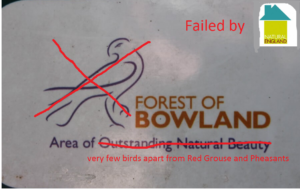
as you know well, your chosen logo – and yet you sit idly by and do
nothing for it. Other National Parks and AONBs have spoken out against
raptor persecution in their areas and yet you remain eerily quiet on the
subject – it’s almost as though you don’t care. And it’s almost as
though you condone what is happening under your noses. That can’t be
true surely?
Q5: Moorland management: management of large areas of
Bowland for game shooting is a problem not an asset. Have you noticed
how the roads, particularly around Abbeystead in my experience, are
littered with released non-native Pheasants which are a road hazard and
which in late summer carpet the road with their squashed remains? How is
the release of such large numbers of these birds an asset to the
natural beauty of the area? There is evidence that Pheasants may
contribute to reptile declines (snakes and lizards) – what evidence do
you have on the health of Adder and Common Lizard populations in
Bowland? A subject on which you could facilitate research?
Bowland is a notorious hotspot for wildlife crimes against protected
birds of prey. Your logo is practically extinct in your AONB whereas 30
years ago there were over 20 nesting female Hen Harriers. You cannot sit
idly by any longer. Why is the AONB not active in finding solutions to
these issues? Why are you not recruiting volunteer rangers to identify
wildlife crimes and report them to the police? Why are you not
highlighting wildlife crime in your consultation? Why are you not
organising local meetings to highlight the problems and seek the
public’s help in finding solutions? Why aren’t you doing more? You could
facilitate a lot of action but you appear to be complacent and inert
over the massive elephant in the room – your AONB is losing its natural
beauty because of criminal action by a few. Visitor experience and information: my visitor
experience would be greatly improved by seeing Peregrine Falcons and Hen
Harriers in your (my! our!) AONB. What are you going to do to
facilitate this?
What plans do you have to change your logo to a dead raptor if things continue as they have done in recent years?
I'm an author and environmental campaigner. One of my passions is ending
the illegal persecution of a wonderful bird called the Hen Harrier.
We've reached our funding target
March 2, 2018
We did it - together! Over 900 of us have raised the money needed to mount our judicial review against Natural England.
And it took four and a half days. You are amazing!
The
speed with which the total was reached just shows how strongly people
feel about this issue. We are doing our bit to get #justice4henharriers.
Thank you - that's all I can say. THANK YOU!
Read More >>
I'm one of a group of like-minded campaigners seeking a better deal
for threatened wildlife. We need your support to challenge the
government to do more, and do the right things, for a persecuted bird,
the Hen Harrier.
Hen Harriers are wonderful birds which are in danger of disappearing
from England. The reason is simple: illegal persecution on grouse moors
(because they eat Red Grouse that people want to shoot for fun).
Cracking down on this wildlife crime is the key to giving the Hen
Harrier a better future, but the Westminster government is doing far too
little about that.
Instead of tackling the key issue of criminality, Michael Gove's
Department for the Environment (DEFRA) has proposed something called
'brood management' which involves removing chicks from nests near grouse
moors. That might help grouse moor owners but it won't help Hen
Harriers. See this article in The Guardian, and this blog
for more details. It's a bizarre proposal and I believe it is illegal
because alternative sensible and effective actions are available.
So I'm initiating a judicial review of Natural England's decision to issue a licence enabling brood management to go ahead.
Persecuted wildlife can't hire lawyers so we must do it for them and
I've got some great lawyers together to fight for the Hen Harrier - they
are really keen to get justice for this bird (and have been captivated
by this video of the male Hen Harrier's skydancing display).
But I need your help to pay the court costs, the costs if we lose
(nothing is certain) and at least some of our lawyers' costs (they have
kindly agreed to work at heavily discounted rates). The first stage is
to raise £5000 to start the process rolling but we need to raise another
£20,000 to see this through to the end. Please help start things off
by donating today - right now please, if you can. Hen Harriers need justice - you can help them get it.
I'll give regular updates on how things are going - here and on my blog Standing up for Nature.
If we raise more money than is needed, the additional funds will be
held for up to a year and spent on other legal work to benefit Hen
Harriers or other environmental causes. Thank you.
How about this for proper, proactive, genuine partnership working to
tackle illegal raptor killing in North Yorkshire, one of the UK’s most
prolific raptor persecution hotspots.
This is really encouraging. There’s no obsfuscation here, just a
clear acknowledgement that raptors are still being illegally killed in
North Yorkshire and an equally clear intention from all the project
partners that this will no longer will be tolerated.
Well done North Yorkshire Police, RSPB, RSPCA, Yorkshire Dales
National Park Authority and North York Moors National Park Authority.
Press release from North Yorkshire Police, 17 February 2018: It’s “talons out” for raptor persecutors as North Yorkshire Police launches Operation Owl
Police are urging visitors to North Yorkshire’s countryside to get
involved with Operation Owl – a new initiative to reduce the number of
illegal attacks on birds of prey in the county.
Under the Wildlife and Countryside Act it is an offence to
intentionally kill, injure or take wild birds. Nevertheless birds of
prey (raptors) are still shot, poisoned and trapped – especially in
areas where the land is managed for driven grouse shooting.
North Yorkshire has more confirmed incidents of raptor persecution
than any other county in England – a situation that North Yorkshire
Police is determined to tackle.
Launching on 17 February, Operation Owl is a
joint initiative by North Yorkshire Police, the Royal Society for the
Protection of Birds and the RSPCA, together with the North York Moors
and Yorkshire Dales National Parks.
As part of the Operation, police will carry out surveillance checks
on known raptor persecution hot-spots at random times to disrupt
offender activity, and work with local landowners to make them aware of
the legal position on raptor persecution. National Park volunteers will
be trained to spot poisoned bait and illegal traps across the parks and
the police are also calling on the public to be the eyes and ears of the
police when out in the countryside.
North Yorkshire Police’s Chief Constable, Dave Jones, is the national
lead on wildlife and rural crime, and the Force has what is believed to
be the largest dedicated rural taskforce in the country.
Sergeant Kevin Kelly is part of that rural taskforce. He said:
“Our wonderful countryside is host to many specially-protected
birds of prey such as peregrine falcons, red kites, buzzards and owls.
It is absolutely unacceptable that people think they can ignore the law
and subject these birds to poisonings, shootings, nest destruction and
the illegal use of spring traps without consequence. We will be doing
everything in our power to catch these offenders, supported by our
colleagues in the RSPB and the volunteers in the national parks. But the
area is huge, so the more eyes and ears we have on the ground the
better. That’s why we’re asking the public to help.”
In particular, the police are asking the public to spot pole traps. Sergeant Kelly explained:
“Trappers are using spring-loaded traps on top of posts to
capture birds of prey that land on top of the post. The bird can
struggle for many hours before the trapper returns to kill them. These
pole traps, as they are called, are illegal. We want the public to help
us find these traps. We’re advising that anyone who sees a pole trap
should “spring” it if they can do so safely, note the location, take a
photo, and call the police on 101 to report it. Our wildlife officers
will take it from there.”
Operation Owl will run for the next year, and North Yorkshire Police
is hoping that the initiative will become a blueprint for other Forces
where there is a high incidence of raptor persecution.
Said Sergeant Kelly:
“Like other forms of rural crime, raptor persecution is not a
problem that the police can tackle alone. We need everyone involved. The
weather will soon start to improve and more people will head out to the
countryside. If everyone keeps their eyes open for illegal traps and
poisoned bait, it will be a massive boost to our surveillance operation.
This is a real opportunity to reduce the number of wild birds that
suffer and die unnecessarily, and send a clear message to offenders that
we will not tolerate this crime in our countryside.”
Commenting on Operation Owl, Guy Shorrock, RSPB Senior Investigations Officer, said:
“The landscape of North Yorkshire attracts huge numbers of
visitors every year. Unfortunately, it also has a terrible history for
the illegal shooting, trapping and poisoning of birds of prey. We are
proud to support North Yorkshire Police with this initiative and would
ask people to report any concerns to them. If people want to speak in
confidence about raptor persecution they can contact us on 0300 9990101“.
Andy Wilson, Chief Executive of the North York Moors National Park Authority, said:
“Raptors are beautiful. They are an essential part of our
National Parks, but their numbers have been diminished over many years
by persecution from shooting interests. We urge everyone to help prevent
illegal persecution and welcome Operation Owl, which the National Park
Authority is actively supporting.”
David Butterworth, CEO of the Yorkshire Dales National Park Authority, said:
“The monitoring data, the number of confirmed persecution
incidents and the absence of some species from large areas of
potentially suitable habitat provide compelling evidence for an
uncomfortable conclusion: illegal persecution is limiting the
populations of some species of birds of prey in the Yorkshire Dales
National Park. I’d like to appeal to the public to join in Operation
Owl to help bring about the changes in attitudes that are so urgently
needed. Only through collective action can the persecution be stopped.” ENDS
The partners have released a short video to help members of the
public to recognise some common signs that raptor persecution is taking
place:
The lottery funded film we've all been waiting for:
Film "Remembering and Restoring The River Roeburn" see above.
Thanks to the National Lottery for funding and to Mark Minard and Bryony Rogers for producing.
It is available free to screen-see above the link.
Reviewed by Peter Reason When our postman handed me the package that contained my review copy of The Lost Words
I blurted out, ‘I’ve been waiting for this!’ In the weeks before its
delivery I had read hugely appreciative reviews in the national press
and on line. The book has benefited from a major marketing campaign from
the publishers, aimed firmly at the Christmas market, and attracted
much attention. So while delighted to get my copy I was also a bit
anxious: would I like it or was it over-hyped? Would I find anything to
write about it that has not already been written?
I took the book to my favourite armchair and slowly turned the pages,
first taking in Jackie Morris’s illustrations, then reading
Macfarlane’s ‘spells’. After a little while I realized that all the
time I had a smile on my face, and I found myself muttering to myself,
‘This is very well done indeed!’ The Lost Words delivers everything it promises.
The story behind the book has been well rehearsed. In 2007, a new edition of the Oxford Junior Dictionary was
published. Many words describing the natural world had been omitted
while words from the ‘technosphere’ such as ‘broadband’ were included in
their place. A group of well-known children’s authors wrote an open
letter in protest. In parallel, concerns have been raised in recent
years about ‘nature deficit’,the fact that children were no
longer allowed to roam around in parks, commons and wild places on their
own, no longer building dens, collecting tadpoles, unable to name
common wildflowers. Richard Louv’s Last Child in the Woods has
attracted much attention; naturalist and broadcaster Chris Packham,
among others, has joined the call for children to get back into the
natural world, showing its importance in his own engaging memoir Fingers in the Sparkle Jar. It
was Jackie Morris who first had the idea of a book illustrating these
lost words—she conceived of it as a ‘wild dictionary’. She asked Robert
Macfarlane if he would write an introduction and this more ambitious
project grew from there.
If words are being lost, if we cannot name our world, can we actually
experience it? Is not language important in perceiving, even conjuring
up our world? If the names are lost, will we care when the beings
evoked are also lost? As I write this, I learn that the population of
flying insects has dropped by some 75% over the past 25 years, yet
another indication that we living in a time of the Sixth Great
Extinction of species in the history of Earth, this time caused by human
impact. How come we collectively pay so little attention to this
destruction, this ‘great thinning’, as journalist Michael McCarthy so
aptly calls it? Are we all asleep? The Lost Words is offered to wake us from our collective nature
deficit, to reclaim words and celebrate a world that seems to be
slipping away from us. The Introduction tells us, ‘You hold in your
hands a spell book for conjuring back these lost words… [to] unfold
dreams and songs, and summon lost words back into the mouth and the
mind’s eye’. As Macfarlane points in the Guardian Review, just as Ged, the magician hero of Ursula LeGuin’s Earthsea
trilogy, has to learn the true names of beings in the Old Speech of
dragons and gods if he is to work his spells, we too must relearn the
magic of words. The
book starts with Acorn and moves through the alphabet to Wren (although
some letters are omitted and others repeated). Each word is represented
in three spreads: the first marking loss or slipping away, where the
letters that make the word are scattered across the page; the second
containing the summoning spell; and the third being a rich illustration
celebrating the word in its wider context. The spells are evocative, as
one would expect from Robert Macfarlane; the illustrations gorgeous,
from the experienced hand of Jackie Morris, who lives up to the
tradition of great nature illustrators, including Arthur Rackham,
currently celebrated in the Victoria and Albert exhibition Into the Woods.
Author and illustrator have worked closely together to conceive and
realize an integration of words and images that is an artwork in its own
right.
This is a wonderful book to offer to a child at Christmas or
birthday; or on no occasion at all, just for the sake of giving a gift
that is beautiful as well as educational.
But this is not just a book for children. It addresses the challenge
of how ‘nature writing’ in its broadest sense can reach a wide audience
and address the ecological calamity of our times. How do we encompass
the loss of other beings in the community of life on earth; and even
more the disturbance of the great cycles of the atmosphere, the oceans,
even of the rocks, that are destabilizing our planet? How do we write
about nature when day after day we learn of some new way in which the
human—mainly Western—fingerprint is to found everywhere; when in many
ways we can no longer distinguish between ‘nature’ and ‘culture’? How do
we all, adults as well as children, re-enchant our damaged planet?
Macfarlane has always been a literary writer. He goes on his travels
accompanied by the writers and poets he knows and loves, notably by
Edward Thomas in The Old Ways. He has written elsewhere about
the importance of language in appreciation of our world; his Twitter
feed features an uncommon ‘word for the day’ that has proved popular and
stimulating. In earlier works he shows how the reclamation of words and
stories helped save the Brindled Moor on Lewis in the early years of
the present century from the construction of a massive wind farm. The
energy company claimed that the moor was a barren place, a wasteland,
certainly disenchanted; and indeed so it might appear to an outsider.
But local people strongly opposed the proposal and devised ways to
re-story the moor, to reclaim and re-enchant it in ‘narrative, poetic,
lyric, painterly, photographic, historical, cartographical’ forms. What
was required, one protagonist argued, was a Counter-Desecration Phrasebook
that would help both name the landscape and the community’s
relationship to it. The Brindled Moor was saved, at least for the
moment. (It is also interesting to note that the speed of development of
wind generation technology suggests that a windfarm built in the first
decade of this century would be obsolescent toward the end of the second
decade; while the moor would be ruined forever.) Words are not just
nice for children, they have practical and political consequences.
Some ‘nature writers’ are birders and old style naturalists, some of
whom study one creature or ecosystem for a lifetime; others are
journalists and broadcasters, photographers and filmmakers, travelers
and eco-philosophers. In pursing this link between language, our
literary heritage and the natural world, Macfarlane is making his
particular contribution, complementing other contributors to this broad
field.
In this collaboration, Robert Macfarlane and Jackie Morris have drawn
together words and images to create a book of spells that promises to
evoke a sense of wonder in us all. As Macfarlane tells us, ‘wonder is an
essential survival skill for the Anthropocene’.
 The
Forest of Bowland AONB is consulting on its next 5-year plan for
2019-24. They would like your views by a week today, 25 May. It’s easy
to fill in the short consultation form – takes about 5 minutes.
The
Forest of Bowland AONB is consulting on its next 5-year plan for
2019-24. They would like your views by a week today, 25 May. It’s easy
to fill in the short consultation form – takes about 5 minutes.

 When our postman handed me the package that contained my review copy of The Lost Words
I blurted out, ‘I’ve been waiting for this!’ In the weeks before its
delivery I had read hugely appreciative reviews in the national press
and on line. The book has benefited from a major marketing campaign from
the publishers, aimed firmly at the Christmas market, and attracted
much attention. So while delighted to get my copy I was also a bit
anxious: would I like it or was it over-hyped? Would I find anything to
write about it that has not already been written?
When our postman handed me the package that contained my review copy of The Lost Words
I blurted out, ‘I’ve been waiting for this!’ In the weeks before its
delivery I had read hugely appreciative reviews in the national press
and on line. The book has benefited from a major marketing campaign from
the publishers, aimed firmly at the Christmas market, and attracted
much attention. So while delighted to get my copy I was also a bit
anxious: would I like it or was it over-hyped? Would I find anything to
write about it that has not already been written? The
book starts with Acorn and moves through the alphabet to Wren (although
some letters are omitted and others repeated). Each word is represented
in three spreads: the first marking loss or slipping away, where the
letters that make the word are scattered across the page; the second
containing the summoning spell; and the third being a rich illustration
celebrating the word in its wider context. The spells are evocative, as
one would expect from Robert Macfarlane; the illustrations gorgeous,
from the experienced hand of Jackie Morris, who lives up to the
tradition of great nature illustrators, including Arthur Rackham,
currently celebrated in the Victoria and Albert exhibition Into the Woods.
Author and illustrator have worked closely together to conceive and
realize an integration of words and images that is an artwork in its own
right.
The
book starts with Acorn and moves through the alphabet to Wren (although
some letters are omitted and others repeated). Each word is represented
in three spreads: the first marking loss or slipping away, where the
letters that make the word are scattered across the page; the second
containing the summoning spell; and the third being a rich illustration
celebrating the word in its wider context. The spells are evocative, as
one would expect from Robert Macfarlane; the illustrations gorgeous,
from the experienced hand of Jackie Morris, who lives up to the
tradition of great nature illustrators, including Arthur Rackham,
currently celebrated in the Victoria and Albert exhibition Into the Woods.
Author and illustrator have worked closely together to conceive and
realize an integration of words and images that is an artwork in its own
right.