Tuesday, 15 August 2023


Killing the Skydancer – new podcast from the Guardian about raptor persecution on grouse moors

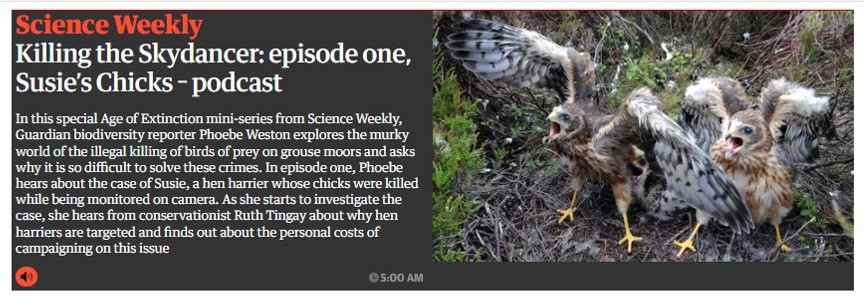
The Guardian has just released the first episode in a mini-series podcast it has produced called ‘Killing the Skydancer‘, which centres on the illegal killing of birds of prey on driven grouse moors.

Episode one introduces Phoebe Weston (Guardian journalist) who read an article on this blog about how a brood of hen harrier chicks were stamped to death in their nest on a Whernside grouse moor in the Yorkshire Dales National Park last year (see here).

Phoebe was so horrified by the story she says she couldn’t stop thinking about it and it led her to want to find out more. This podcast series is the result of her investigation as she travelled to the Peak District and the Yorkshire Dales to look for hen harriers and to interview some people from both the conservation sector and the grouse shooting industry.

Episodes two and three will be out tomorrow and Thursday.

The link to listen to episode one (21 mins) is HERE


Friday, 26 May 2023


Friday, 19 May 2023


Hen harrier ‘disappears’ in Bowland: Lancashire Police appeal for information

Lancashire Police are appealing for information after the sudden ‘disappearance’ of a satellite-tagged hen harrier earlier this month.

This was posted on the Lancashire Rural Police Facebook page yesterday:

Following information being received that a sat tagged hen harrier had gone missing, and the tag suffering catastrophic failure, we have been working with our colleagues in the National Wildlife Crime Unit to try to locate the bird.

Today we have conducted a section 19 search, utilising tracking equipment, where the harrier was last known to be, this was in the Mallowdale area near to Kirkby Lonsdale.

Unfortunately we were not successful in locating the bird, which went missing over the 4th and 5th May, we are asking for anyone who has any information to contact Lancashire Police Rural Crime Task force via 101 or email RuralTaskForce@lancashire.police.uk and quote log number LC-20230516-0307‘.

There aren’t yet any further details about which hen harrier this is.

The harrier ‘disappeared’ the same day that the RSPB announced that 20 hen harriers had ‘vanished’ in the last year alone, most of them on grouse moors (here) and the day before Natural England described the mutilation of another hen harrier, whose leg and head had been ripped off whilst the bird was still alive (here).

The latest disappearance took place a week before the RSPB published a new scientific paper which confirms the ongoing and illegal killing of hen harriers on UK grouse moors (see here).

The latest ‘disappearance’ also coincided with Natural England’s announcement that the five-year hen harrier brood meddling ‘trial’ (conservation sham) is set to continue for a further five years (here), despite knowing that at least 92 hen harriers have been confirmed killed or have ‘disappeared’ since the ‘trial’ began in 2018 (here).

Now there’s yet another one to add to the list. This is the 8th hen harrier to ‘vanish’ since the start of this year, and it’s still only May.

How many more?

UPDATE 19th May 2023: The Forest of Bowland AONB posted the following on its website yesterday:

Yesterday, Lancashire Police’s Rural Crime Taskforce reported the disappearance of a satellite-tagged hen harrier in the Forest of Bowland AONB. 

The bird went missing, with the tag suffering catastrophic failure, over 4th/ 5th May in Mallowdale, an area of moorland to the south of the village of Wray.  The Rural Taskforce and National Wildlife Crime Unit have since carried out a search of the area but have been unsuccessful in locating the missing bird.

Lancashire Police have issued an appeal to the public for information.  Please contact the Rural Crime Taskforce via 101 or email RuralTaskForce@lancashire.police.uk and quote log number LC-20230516-0307.

Elliott Lorimer, Forest of Bowland AONB Partnership Manager commented:

“The disappearance and failure of this satellite tagged Hen harrier is very concerning.  The Forest of Bowland is often considered a stronghold for this protected species, with conservation efforts in the area aiding the recovery of this threatened bird.  So, any loss in such circumstances is particularly upsetting.  I would strongly urge members of the public to contact Lancashire Police if they have any information that could relate to the disappearance of this bird.”

Monday, 19 September 2022

Insect photos from the farm by Rod Everett


Tuesday, 8 March 2022

Hen Harriers (not) in Bowland

Six more satellite-tagged hen harriers ‘disappear’ in suspicious circumstances

Six more satellite-tagged hen harriers have gone missing in suspicious circumstances, according to the most recent data published by Natural England last Friday, 4th March.

Natural England’s previous hen harrier update, published in December 2021 (here), identified three other tagged harriers that had vanished in the summer/autumn of 2021.

Now there are six more. Three disappeared in November 2021, one in December 2021 and two in January 2022. Neither the police or Natural England have issued any media press releases or made any public appeals for information about any of them.

[Photo by Dave Soons]

Here are the details of the latest six to vanish, in chronological order:

Brood meddled hen harrier R2-F1-20, female, hatched in 2020 at nest site BM R2 Cumbria, last known satellite tag fix on the edge of a grouse moor (believed to be on Arkengarthdale Estate) in the Yorkshire Dales National Park on 15th November 2021, grid ref: NY959039.

Hen harrier Val (Tag ID 213849), female, hatched in North Pennines in 2021, last known satellite tag fix in Cumbria, west of Coniston Water on 19th November 2021, grid ref: SD256921.

Hen harrier Percy (Tag ID 213847), male, hatched in Northumberland (nest site Northumberland 1) in 2021, last known satellite tag fix in the Scottish Borders nr Fala Moor on 19th November 2021, grid ref: NT410615.

Hen harrier Jasmine (Tag ID 213848), female, hatched in Cumbria in 2021, last known satellite tag fix on a grouse moor (High Rigg Moor, Middlesmoor Estate) in the Nidderdale AONB, North Yorkshire on 12th December 2021, grid ref: SE034733.

Hen harrier Ethel (Tag ID 213852), female, hatched in Northumberland (nest site Northumberland 2) in 2021, last known satellite tag fix in Hexham on 9th January 2022, grid ref: NY936632.

Hen harrier Amelia (Tag ID 213846), female, hatched Bowland in 2021, last known satellite tag fix in Bowland on 26th January 2022, no grid reference provided.

These suspicious disappearances are no longer shocking, not even when six of them are reported at the same time.

The complete lack of media appeals about any of them from Natural England and the various police forces is no longer shocking.

The lack of prominence in the recent update blog that Natural England has given these latest disappearances is no longer shocking.

The zero prospect of any so-called investigation progressing to a prosecution is no longer shocking.

The complete silence from the grouse-shooting industry about this continued organised crime is no longer shocking.

It’s all just so routine, isn’t it?

It doesn’t have to be. It’s up to you, as blog readers, to bring this scandal to the attention of your elected representative(s) and demand that they put pressure on the Government to take action.

I’ll update the ever-increasing list of hen harriers known to have been illegally killed in the UK or that have vanished in suspicious disappearances since 2018, most of them on or close to grouse moors, and will post it here shortly. It would be good if you could then send that list to your local MP so they can’t claim to be ignorant of what’s going on.

Monday, 10 May 2021

The Wonderful Gift of Dandelions

Thursday, 29 April 2021

Fell Pony Adventures, Cumbria

Sunday, 27 September 2020

Channel 4 bats away shooting industry hysteria © Raptor Persecution UK

On Monday evening Channel 4 News included an explosive piece about grouse shooting in the North York Moors National Park and its association with the illegal killing of birds of prey.

Fronted by veteran war correspondent Alex Thomson, it was a follow-up to an item that was broadcast back in May where Alex had again focused on the illegal killing of birds of prey on grouse moors in the North York Moors National Park as well as in the Nidderdale AONB (see here).

Monday’s piece was car-crash viewing if you were a member or supporter of the grouse shooting industry, in what was an extraordinary display of arrogance, denial and entitlement from a number of individuals involved with a grouse shoot. All those previous media campaigns, carefully-crafted to showcase this industry to the general public in the best possible light, shot down in tatters during a prime time viewing slot before our very eyes. If you missed it, this six minute film is well worth your time.

Predictably, since the programme aired some members of the shooting industry (which, remember, professes a ‘zero tolerance‘ for raptor persecution) have been in an absolute rage on social media, angrily shouting about how unfair it all was, how dare a high profile journalist question anybody involved in this noble ‘sport’ for their views on illegal raptor persecution, spitting blood that there wasn’t an alternative opinion given (conveniently forgetting that the Moorland Association was given the opportunity to comment, but didn’t).

They were also probably furious that several members of the local community were filmed, dispelling quite a few myths and debunking the propaganda often painted of a moorland community in harmony – a rural idyll where local residents are deliriously enthralled by the activities of the local grouse moor managers and thankful for the boost that grouse shooting brings to the local economy, without which the local community would apparently collapse. Nah, these Goathland residents weren’t having any of it. Kudos to them for standing their ground.

Don’t be surprised to see the launch of a campaign /petition calling for Alex Thomson’s dismissal from Channel 4  –  this thuggish industry has a well-deserved reputation for trying to shoot the messenger, usually by generating a nasty little smear campaign to undermine the integrity of those who dare to speak out against the industry’s criminality and environmental destruction.

Meanwhile, several individuals have already been making complaints about the programme directly to Channel 4. Channel 4 is having none of it. Here’s the standard response that has been sent back:

Brilliant! If you’d like to send Channel 4 a message of support for (a) broadcasting the footage during its main evening news schedule and (b) having the balls to stand up to the resulting howling hysteria of the grouse shooting industry, you can use this form (here) to show your support and appreciation.

Saturday, 11 July 2020

For Peat's Sake

Friday, 26 June 2020

Hen harriers - an inconvenient truth


Natural England recently gave the green light for the controversial hen harrier brood management scheme to go ahead for a second year. However, has the government been sufficiently open about events last year near the very first brood management site in a notorious part of North Yorkshire?
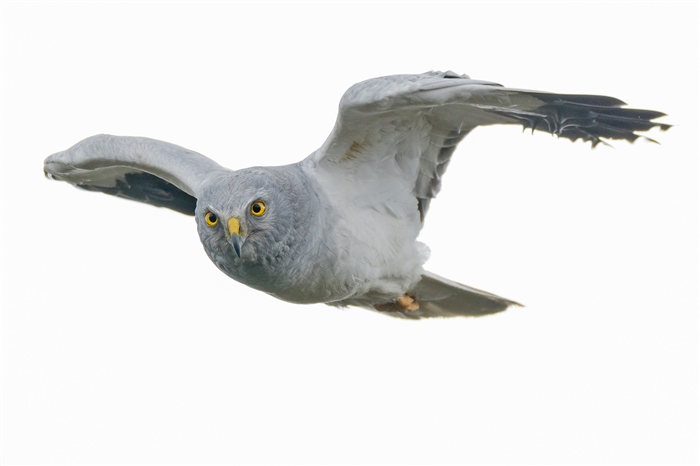
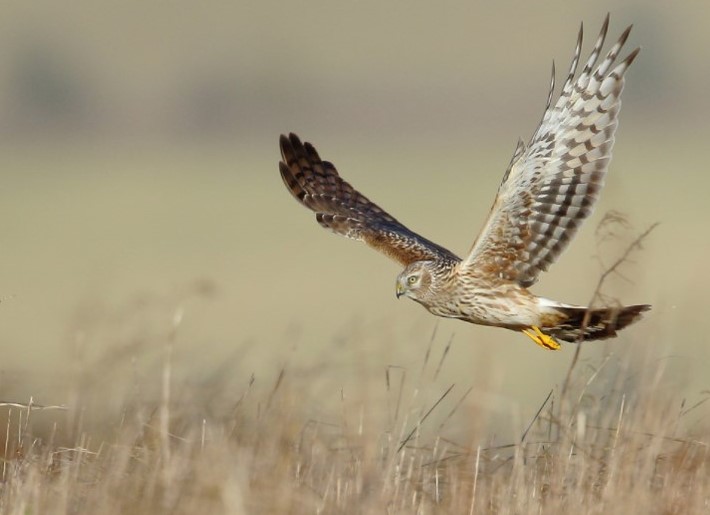
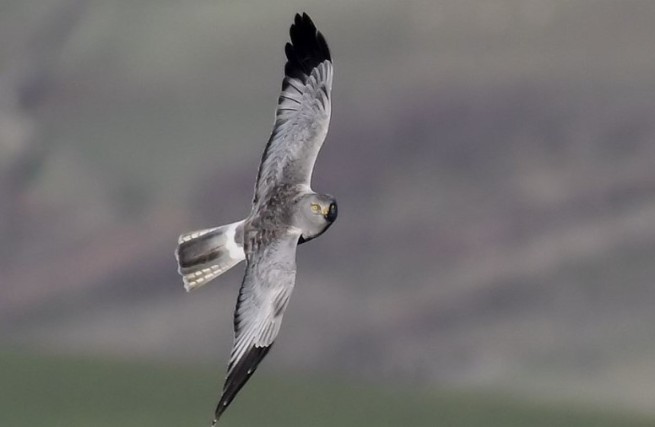
A male hen harrier - stunningly beautiful but still not welcome in large parts of our uplands.  Pete Morris (RSPB)
We can reveal that two hen harrier nesting attempts failed in suspicious circumstances near the brood management site in 2019. To date, this fact has not been publicly mentioned by Defra or Natural England (NE), not even in their own brood management report. Why is this?
Let’s rewind a bit.
In January 2016 Defra launched its Hen Harrier Action Plan, which included the controversial brood management scheme, to be carried out by Natural England (NE). This involves removing hen harrier eggs or chicks from driven grouse moors when pairs nest within 10km of each other on a grouse moor. The birds are then reared in captivity before being released into upland habitat. The RSPB does not support brood management: we believe that illegal persecution must be tackled first and foremost. The RSPB and Dr Mark Avery are both currently in appeal proceedings against brood management.
The brood management trial, due to run for five years, started in 2019 on the Swinton Estate in North Yorkshire. Five chicks were removed from a nest, fitted with satellite tags, and released elsewhere later that season. Along with another pair on the estate, this was the first successful breeding of hen harriers in North Yorkshire since 2007. This area of North Yorkshire, dominated by driven grouse estates, has an appalling history of raptor persecution and repeated hen harrier breeding failures due to suspected human interference.
However, in August 2019, Defra and NE announced triumphantly  ‘A Record Breaking Year for Hen Harrier breeding’ with 15 nests producing 47 chicks. In fact, only 12 nests were successful. In relation to the three unsuccessful nests it stated: ‘The three nests which failed were all in Northumberland – two were lost to bad weather and the third was predated’.
Twelve successful nests is a far cry from the 300 breeding pairs England could support. 
More nest failures
However, the government media release announcing the 2019 breeding results filed to mention another two failed nesting attempts on grouse estates in North Yorkshire, within just five kilometres of the brood managed pair. We don't know who may have been responsible for these failures. NE knew all about these, and had spoken with North Yorkshire Police, so why miss out this part of the story?
One of these failed nests was on the edge of an estate. As well as on-the-ground monitoring information, we also received disturbing information from a very reliable source which may – we don’t know for sure – explain why this nest failed. Our source told us that a gamekeeper from another nearby estate had shot the male bird and the nest site had later failed. Whilst this is only an allegation, it did fit with the events on the ground, which were unknown to the person who contacted us. This information was passed to the police and the National Wildlife Crime Unit.
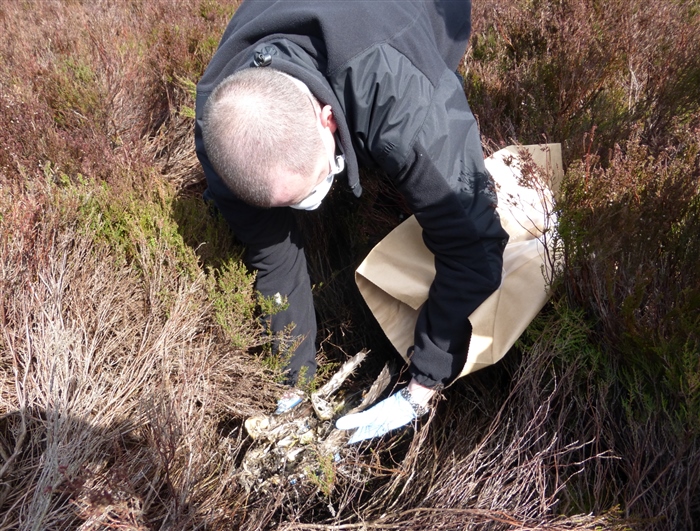
The body of hen harrier 'River' being recovered by North Yorkshire Police in April 2019.  She had been shot. H Jones (RSPB)
Seeking information
The RSPB made requests under Freedom of Information (FOI) and Environmental Information Regulations (EIR) to Defra, Natural England, North Yorkshire Police and the National Wildlife Crime Unit. We asked for details of any communication exchanges since the start of November 2018 –
  • in relation to hen harrier brood management in North Yorkshire plus any suspected, potential or confirmed persecution incidents involving hen harriers.
  • with sporting estates in North Yorkshire in relation to hen harrier brood management or any suspected, potential or confirmed persecution incidents involving hen harriers.
The date (November 2018) coincided with the RSPB filming of a masked man with a firearm in a hen harrier roost on the Swinton Estate in North Yorkshire, and the last satellite transmission from hen harrier ‘River’ from the same estate. River’s body was later discovered on another part of the estate the following spring. She had been shot.
Amongst the material supplied by NE was confirmation they had received from the police the information, originally from the RSPB, about the allegation that a gamekeeper had shot the male of one of the failed nesting pairs.
However, we were surprised to see that there was no Defra or NE correspondence, either internal or with other government agencies or sporting estates, concerning the two nesting attempts which had failed in highly suspicious circumstances.
As part of the brood management scheme there is a requirement ‘To produce an annual report to be assessed by Natural England ornithologists, to assess the progress of the trial’. We decided to wait to see what was in this report. We understand this was completed earlier this year so why it has not been published online is unknown. However, we were recently sent a copy of this report obtained via an EIR request by a Raptor Worker. The report introduction states: ‘In 2019 an estate in North Yorkshire had two Hen Harrier nests on it within 10km of each other. Under the trial parameters this qualified them to undertake brood management. This report deals with the experience gained and lessons learnt form undertaking the brood management intervention on one of these two nests’.
The report mainly focusses on the technical aspects of brood management. You would have hoped the suspicious failure of two nesting attempts so close to the brood management location fell under ‘experience gained & lessons learned’. Even if NE claim this is outside the remit of the report, then we are still left asking the question: were NE ever going to publicly mention these failed nesting attempts? I suspect not.
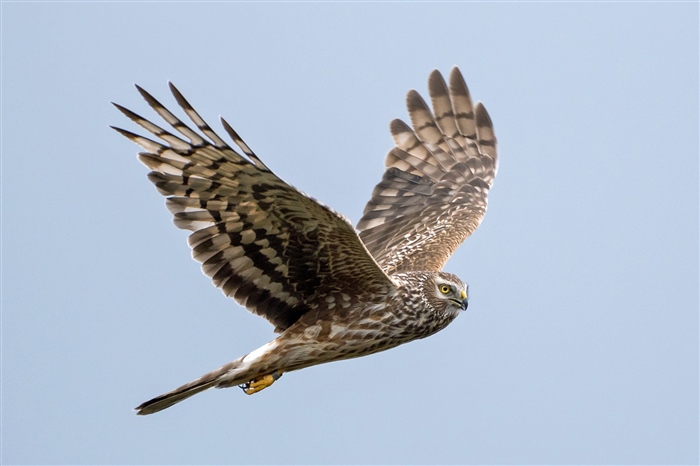
A female hen harrier - just a handful of breeding pairs in England, though there is enough habitat for over 300. Pete Morris (RSPB)
A lack of openness
This inconvenient truth is not in their joint August 2019 media release. It doesn’t feature in any of their correspondence supplied to us, or the 2019 brood management report. It was not even raised at the last two Raptor Persecution Priority Delivery Group meetings post August 2019.
It would seem important for Defra and NE to ensure absolute transparency about events that are taking place given the exposure the brood management scheme has received. This does not appear to have happened.
On 22 May this year NE announced that brood management licences were being renewed for 2020. Days later it emerged that all five brood-managed chicks from 2019 are now ‘missing’. The fact that there has been no update from Defra or NE this year about these birds, and what information is available had to be requested, displays a lack of openness. Whether persecution is behind the disappearance of some, or even all, of these birds, is unknown, though the decision to use a different, and possibly less reliable, type of satellite tag has further clouded the picture.
Hopefully, going forward we will all be given real transparency about the BM process and on the threats still being faced by our hen harriers.
No prosecution for shooting of a hen harrier in Bowland

On 18 October 2019 a member of the public witnessed what he believed to be the shooting of an adult male hen harrier near White Syke Hill in the Forest of Bowland Area of Outstanding Natural Beauty (AONB).
North Yorkshire Police (whose force area covers that tiny part of Bowland) put out an appeal for information five months later (see here).
A few days later, North Yorkshire Police announced that an arrest had been made in this investigation and the suspect had been released pending the results of a forensic analysis (see here).
[A male hen harrier, photo by Eddie Maguire]

Unfortunately the police have now concluded there is insufficient evidence to proceed with a prosecution.
Inspector Matt Hagen of North Yorkshire Police’s Rural Task Force said: “This case is an all too familiar scenario where we have information from a credible source, but unfortunately the evidence is not strong enough to meet the threshold where we would ask the Crown Prosecution Service to make a charging decision, even after the arrest and interview of a suspect.
I would like to take this opportunity to encourage anyone with any information regarding any individuals who are involved in raptor persecution to come forward and report it to the police and assure them they will be taken seriously and the matter will be investigated.”
This is a disappointing result, of course, but as many blog readers will know, securing sufficient evidence in these cases is notoriously difficult. Full credit to North Yorkshire Police for giving it a go. This case didn’t fail for lack of effort and at least that suspect will now be on their radar.
As far as we’re aware, North Yorkshire Police are still investigating the alleged shooting of another hen harrier on another Yorkshire grouse moor (see earlier blog here) so fingers crossed for a prosecution on that one.
Now that the Bowland investigation has ended, part of the eyewitness report of the hen harrier being shot and removed from the moor has been published by the RSPB (see here) and it makes for a disturbing read.

Thursday, 11 June 2020

Monday, 13 April 2020

North of England Raptor Forum

NERF’s ‘Most Wanted’

‘The price of success is hard work, dedication to the job at hand and the determination that whether we win or lose we have applied the best of ourselves to the task at hand’.
Vince Lombardi 1913 – 1970
The thoughts, as expressed by Lombardi, exactly identify the characteristics that NERF looks for in the individuals who are awarded the NERF Certificate of Appreciation. All of the recipients have demonstrated their total commitment to protecting birds of prey in the North of England.
The dedication of two legendary Raptor Workers (Bill Hesketh and Bill Murphy) is recognised by NERF
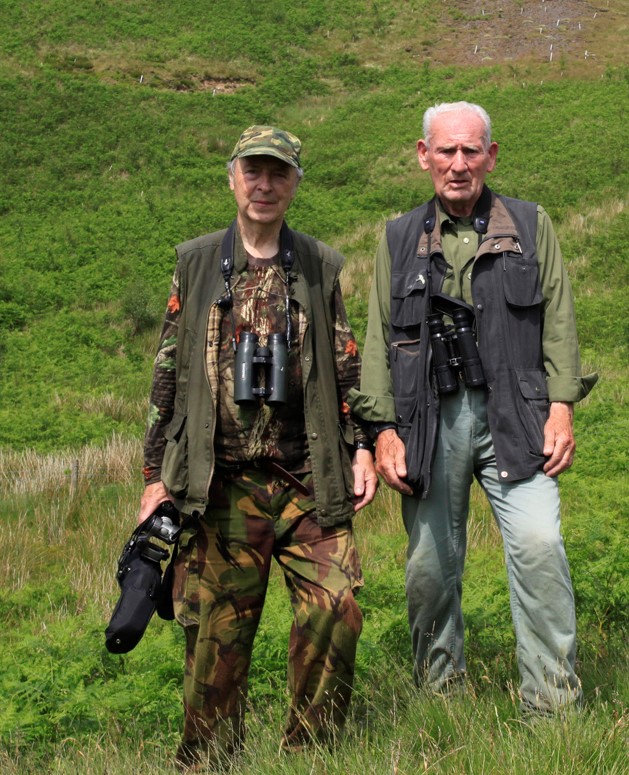
The history of ornithology is littered with explorers who travelled the globe identifying new species, in the days when travel was all but impossible. There are biologists, statisticians, scientists and all manner of academics who bring both old and new avian information to us almost daily. Our bookshelves groan under the weight of their combined literary output. Whist we acknowledge and celebrate the work undertaken by this group of ornithologists we must never forget that the academic world of ornithology is under-pinned by a vast network of millions of ‘ordinary’ birders. For more than a century birders who have collectively spent countless hours, voluntarily surveying and monitoring birds whilst keeping meticulous notes to be shared with the rest of the birding community. A handful of these ‘ordinary’ birders achieve legendary status amongst their peers and NERF is fortunate enough to have two such legends within its ranks.
The names Bill Hesketh and Bill Murphy are synonymous with monitoring and protecting birds of prey in the Forest of Bowland. It is impossible to overstate the fantastic contribution that they have made to our collective knowledge over five decades. Not only have they collected a vast wealth of data they have touched the lives of all of us who know them.
Mick Demain is an extremely talented wildlife artist, a member of NERF and he is also the RSPB Warden working on the United Utilities / RSPB Reserve in the Forest of Bowland. Here Mick recounts his relationship with the Bills.
“I first encountered Bill Hesketh and Bill Murphy, affectionately known as the two Bills, on a long sweeping windswept fell on the eastern edge of Bowland, they approached me and introduced themselves and the conversation lasted no more than a couple of minutes before we parted, the date was 10th May 1992 and although we didn’t know it at the time it would be eighteen years before our paths crossed again and this time we would go on to become great friends.
In 2010 I became involved with the RSPB in Bowland and in 2012 I became RSPB seasonal warden at which time I adopted a team of volunteers, including the Bills who had a great knowledge of Bowland and its birds. Their experience, going back fifty years, has been invaluable to the RSPB.
As the years have passed the friendship has grown and they have been a massive help to me with the fieldwork and great companions on many walks into remote areas to check and monitor sites. I can’t envisage a day when the Bills will not be here to help for they have become a part of Bowland and certainly for me it won’t be the same without them.
These two guys have put in countless hours at a considerable cost to themselves and the RSPB owes them a massive debt of gratitude.”
We all owe them a debt of gratitude and it is with great pleasure that we award the Bills NERF Certificates of Merit.
NERF
April 2020
Dr. Cathleen Thomas, PhD
Project Manager, RSPB Hen Harrier Life Plus Project

Monday, 3 February 2020

Help Bees By Not Mowing Dandelions

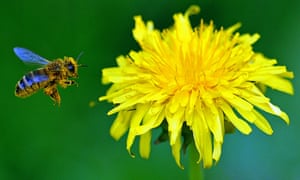
Help bees by not mowing dandelions, gardeners told. Plants provide key food source for pollinators as they come out of hibernation 

A bee flies next to a dandelion flower near Warsaw
Each dandelion head has up to 100 individual flowers. Photograph: Janek Skarzynski/AFP/Getty Images       

Gardeners should avoid mowing over dandelions on their lawn if they want to help bees, according to the new president of the British Ecological Society.
Dandelions – which will start flowering in the UK this month – provide a valuable food source for early pollinators coming out of hibernation, including solitary bees, honey bees and hoverflies.
Each dandelion head contains up to 100 individual flowers, known as florets, which contain nectar and pollen. There are 240 species of dandelion in the UK.
Prof Jane Memmott said: “If dandelions were rare, people would be fighting over them. Because they’re common, people pull them out and spray them off and all sorts of horrible things. Just let them flower.”
Memmott, who took over as president of the BES at the start of this year, is also a professor of ecology at the University of Bristol.
She said gardeners should avoid planting too many “pompom shaped” flowers, such as old English roses and dahlia, because they focus so much of their energy on producing petals and have very little nectar and pollen. “As a rule, if you can see the pollen and nectar parts of a flower without pulling back petals, then it’s OK for pollinators,” she said.
Carrots that have flowered, or “bolted”, and onions in unkempt vegetable gardens are also some of the best plants for pollinators.
“People are a lot tidier than they used to be. This whole business of keeping your lawn clipped and pulling the weeds out is part of some British obsession with tidiness,” Memmott said. “If you look back at old pictures, people weren’t as tidy. I think bohemian untidiness is what we’re aiming for – you don’t want it to look like neglect.”
Leaving the grass to grow 8-10cm (3-4in) tall means clovers, daisies, self-heal and creeping buttercup can also flower. “You can’t personally help tigers, whales and elephants but you really can do something for the insects, birds and plants that are local to you,” said Memmott, who encouraged gardeners to halve the amount of mowing they do.
The global mass of insects is falling by 2.5% a year and many could be extinct within a century, according to a global scientific review last year.
The charity Buglife encourages people to leave a strip of garden that is cut only once in autumn and once in spring. “An awful lot of lawns, especially in older houses, will be built on old meadows so wildflowers come up quite quickly. In a new house they might take a bit longer as they could have had a turf put down,” said Paul Hetherington, the director of communications at Buglife.

Help bees by not mowing dandelions

Wednesday, 17 July 2019

The Little People

Sunday, 2 June 2019

Why We Should Listen to Trees

Why we should listen to trees

When life gets too much, most of us try to get away from it all. Some might head to the pub, play football or knit a jumper. But if you really want to take a break and restore, a dose of nature might be the best tonic – spending time in natural environments has been shown to boost physical and mental health.
Even just listening to the sounds of nature could help us to relax, an idea being explored in a new experiment launched by Radio 4 as a study accompanying a new nine-part futuristic eco-drama called Forest 404.
Alex Smalley, a PhD researcher working on the Forest 404 experiment, gives his top tips on how to make the most of the stress-busting benefits of nature, no matter how much time you do – or think you don’t – have…
Spending time just taking in the forest atmosphere can lower the stress hormone cortisol, decrease blood pressure and calm pulse rates.

1. Dive in


If you’re lucky enough to live near the countryside or coast, there’s nothing like getting out for a walk, cycle, run or swim. These kinds of natural environments can promote physical activity; so-called “green exercise” has been shown to improve people’s self-esteem and mood.
Data suggests that people in the UK tend to be happiest when they are by the coast.
But contact with nature can happen in many other ways too, and spending time in your garden or local park can be just as good. These natural spaces can reduce stress and anxiety, help us sleep better, and boost pro-social behaviours. Evidence is mounting and practitioners are taking note; doctors in Shetland can now prescribe “a dose of nature” to their patients, with similar trials recently taking place in Cornwall.

2. Go green

In Japan, the practice of shinrin yoku – literally, “forest bathing” – makes a good case for taking a walk through your local woodland. Researchers there have found that spending time just taking in the forest atmosphere can lower the stress hormone cortisol, decrease blood pressure and calm pulse rates. In the UK, studies have shown that urban parks and gardens can provide long-lasting impacts on mental health; and that larger areas of green space could act as a buffer against stressful events.
There’s still a lot we don’t know about how these mechanisms work, but nature’s ability to provide a feeling of calm fascination, as well as a sense of being away from day-to-day activities, seems to be the key.

3. Is blue best?

Medics were prescribing convalescence by the sea as far back as the 18th century, but it’s only been in the last decade that evidence for a “blue health” effect has emerged, with studies showing that people who live close to the coast tend to have better health and higher life satisfaction than those who reside inland. Data suggests that people in the UK tend to be happiest when they are by the coast, and research has directly pitted green spaces (like the countryside) against rivers, lakes and the ocean. Blue spaces repeatedly come out on top but there might also be a sweet spot; one study suggested that a scene consisting of one-third green and two-thirds blue was most preferred. People make over 500m visits to England’s blue spaces each year, so you’ll be in good company if you venture out.

4. Bring the outside in

Many of us don’t have access to a natural environment, or might have difficulty getting outside for other reasons. Fortunately, quite a bit of evidence suggests that simply having a view of nature, whether real or digital, can deliver similar benefits. One seminal study from the 1980s found that patients could recover from surgery more quickly if their window provided views of nature, and researchers have used pictures and videos of natural settings to demonstrate a range of other positive effects, from improved mood to an enhanced ability to complete complex tasks.
Getting out to your local aquarium has also been shown to boost wellbeing, and watching nature programmes such as Planet Earth can elicit feelings of joy while reducing negative feelings like tiredness. So if you can’t get out, bring the outside in!

5. Listen up!

Much of the research into the effects of the natural environment on health and wellbeing has focused on vision. Yet interactions with nature are multi-sensory, with sound, smell and touch playing a vital role in our experience, particularly for people with visual impairments. Listening to birds singing, rivers flowing, or waves lapping can help people relax and restore, and the myriad videos of these soundscapes on YouTube demonstrate their potential power.
Feeling part of something greater than ourselves might just make us more altruistic and willing to help others.
But there’s still a lot we don’t know about what sounds people prefer, how they might impact wellbeing, and how best to harness their restorative potential. That’s where our Forest 404 experiment comes in – we want to understand how people across the UK respond to the sounds of nature and you can help us! Find out more and take part here.

6. Awesome experiences

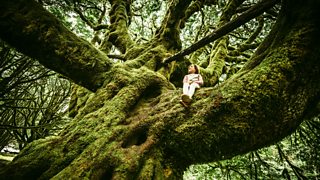
A new area of research has started to suggest that awe-inspiring experiences can improve mood and, excitingly, make us less selfish. Nature is great at producing awe; watching a pod of orcas breaching; standing beneath a canopy of giant trees; or observing the view from a mountain top can all create a sense of wonder and amazement. By making us feel small and part of something greater than ourselves, these awesome experiences might just make us more altruistic and willing to help others.
While awe isn’t an easy feeling to elicit, new advances in virtual reality mean we might be able to put people in the grand canyon, on the summit of Everest, or at the bottom of the ocean with just the flick of a switch. The future could be bright – it could be awesome!

7. The new cigarette break?

Cigarette smoking used to be a common reason for regular breaks away from work or social situations, with people often heading outside. As smoking continues its decline (currently down to 15% of adults in the UK), these breaks could be replaced with short doses of nature. Making time for regular pauses by taking a walk outside, watching a quick nature video, or listening to a two-minute soundscape, could help us to manage the strains of a busy work life. Meditation is also becoming a popular technique for dealing with stress, and newly-released research suggests that combining mindfulness with nature encounters could deliver even greater benefits.
There’s still a lot we don’t know about how nature could benefit health and wellbeing, and we need to remember that spending time in natural environments can also present risks. Nonetheless, the next time you’re frustrated, stressed or anxious, try taking a dose of nature – it might just help you feel better.
Find out more about Radio 4’s Forest 404 experiment, and take part.

Thursday, 2 May 2019

Backsbottom Farm Butterfly Postcard


Friday, 12 April 2019

Backsbottom Farm butterflies and moth (photos Rod Everett)


For Butterfly Conservation
Comma


Meadow brown

Painted lady

Ringlet

Silver y moth

Small copper

Sunday, 17 February 2019

Backsbottom Farm in Discover Bowland Guide

The latest issue page 31-33 has an article by Mark Sutcliff who interviewed Rod at Backsbottom.                                                   
                                             © Forest of Bowland AOB © Mark Sutcliff


Thursday, 10 January 2019

Richard Shilling's Nature Art Film

Included in this film is the River Roeburn running through Backsbottom Farm near to Roeburnscar
Richard's new film exploring his ever expanding nature art attempting to research all mediums and materials found in nature and featuring his recent collaborations with
https://www.youtube.com/gravityglue.
See more at
https://RichardShilling.co.uk,
https://www.facebook.com/richardshill...,
https://www.instagram.com/richardshil....
Music:-
Namaste - Audionautix (https://Audionautix.com) Reverie - Purple-Planet Music ((https://Purple-Planet.com) The Logs Burn Slower Here - Geotic (https://Geotic.bandcamp.com) Lusciousness - Asher Fuller Blue Boi - Lake Inspired (https://soundcloud.com/lakeyinspired)